Claude & Codex · Agentic Coding
Goal, loop, brainstorm: three ways to run the agent's loop
Three things people call Claude Code skills are a command, a bundled skill, and a plugin skill. What each is, and which phase of the work it runs in.
· 3 min read
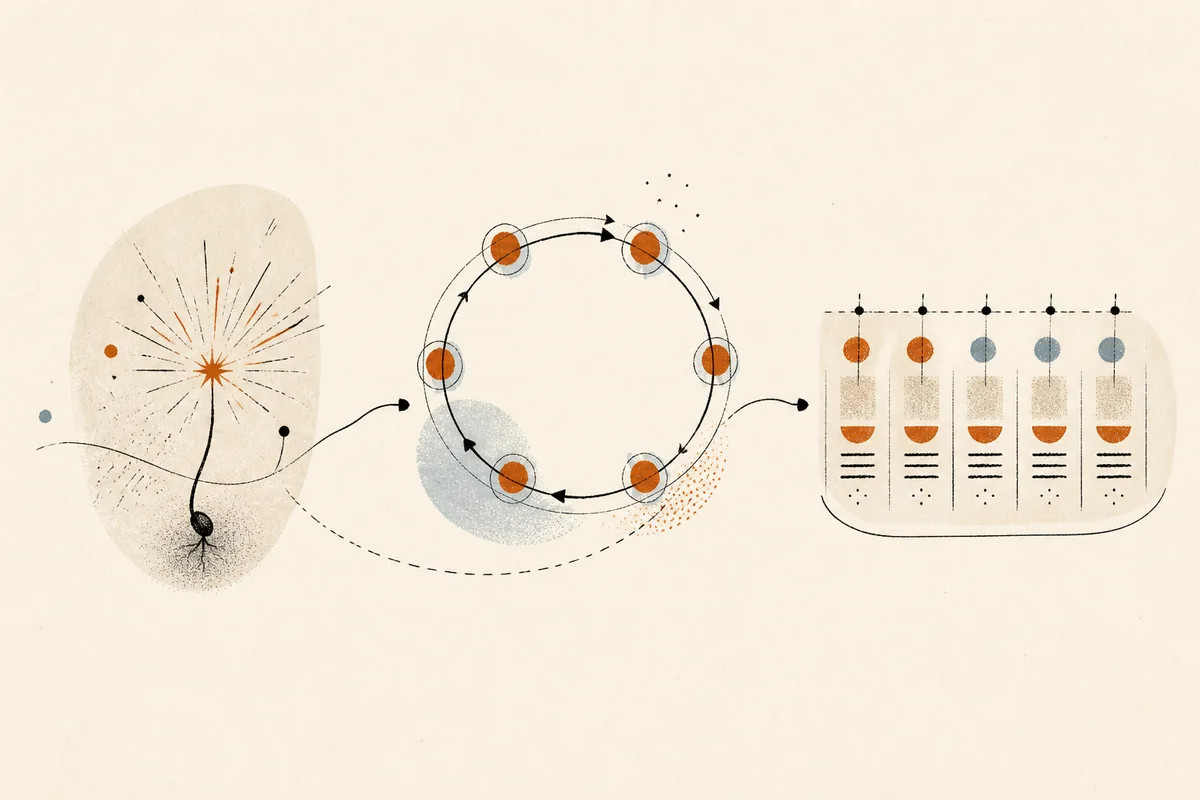
Three things get grouped under “Claude Code skills” in the workflow
conversations I have: /goal, /loop, and brainstorming. Two of them are
skills and one is not, and the label hides the distinction that
matters: each runs at a different phase of a task. One runs
before I build, one runs until a condition holds, one runs on a cadence.
First, what they are on paper. /loop is one of the bundled
skills that ship with Claude Code,
listed next to /debug and /code-review. /goal is a built-in command; the
docs describe it as a wrapper around a session-scoped Stop
hook. Brainstorming is a third-party
plugin skill from Jesse Vincent’s superpowers
framework, installed separately. So the
honest grouping is one command, one bundled skill, one plugin skill. The
grouping I find useful ignores all of that and asks when each one fires.
Brainstorming before implementation
The brainstorming skill opens with an instruction to itself: “You MUST use this before any creative work.” It “explores user intent, requirements and design before implementation,” asking questions one at a time rather than in a batch, and it holds a hard gate: no code, no scaffolding, until it has presented a design and I have approved it. It proposes two or three approaches with trade-offs, presents the design in sections, and writes a spec file before any implementation skill runs. This is the loop that runs when there is nothing to iterate on yet, and its output is the spec the later phases build against.
/goal and its completion condition
/goal (Claude Code v2.1.139 and later) sets a completion condition and keeps
working across turns until the condition is met. After each turn a small fast
model, Haiku by default, checks whether the condition
holds; a “no” sends the model back with
the reason as guidance for the next turn. The evaluator judges only what the
main model has already surfaced in the conversation, so the condition has to be
something the transcript can demonstrate, such as a test result or a clean
git status. I dissected this loop against a days-long model run in a separate
note on /goal; the short version is that
an external check is more reliable than the model’s own sense of done, a pattern
I keep returning to in agentic coding best
practices.
/loop and its schedule
/loop re-runs a prompt on a schedule while the session stays open. Give it an interval and a prompt (/loop 5m check the deploy) and
it runs on a fixed cadence. Give it a prompt with no interval and Claude picks
the delay each iteration, between one minute and one
hour, waiting less while a
build is finishing and more when nothing is pending. Give it nothing and it runs
a built-in maintenance prompt: continue unfinished work, tend to the branch’s
pull request, run cleanup passes. Recurring loops expire seven days after
creation, which bounds how
long a forgotten one can run. The keep-or-discard
shape here is the same one I used for parameter
optimization, and the SKILL.md
format /loop rides on is the portable one I traced across
agents.
Which one to reach for
The /goal docs put the three side by side by the question that matters, which
is what starts the next turn. /goal’s next turn starts when the previous one
finishes and stops when a model confirms the condition. /loop’s starts when an
interval elapses and stops when I stop it or Claude judges the work done.
Brainstorming, however, sits before both, where the next turn is another
question and it stops when I approve the design. So the rule I use: (1)
brainstorm before there is code, (2) /goal when done has a testable
definition, (3) /loop when the work arrives on a clock. The packaging determines the install step, and the phase determines
which one I reach for. Next I will run
one task through all three in sequence: brainstorm to a written spec, run
/goal until the tests pass, run /loop to keep them passing, and note
where the handoffs lose information.