Agentic Coding · Claude & Codex
Steering agents from my phone: a terminal stack vs Claude Code Remote Control
Tailscale, tmux, mosh, and a mobile terminal let me steer long agent runs from my phone. Why that plain stack still outperforms Remote Control for me, for now.
· 4 min read
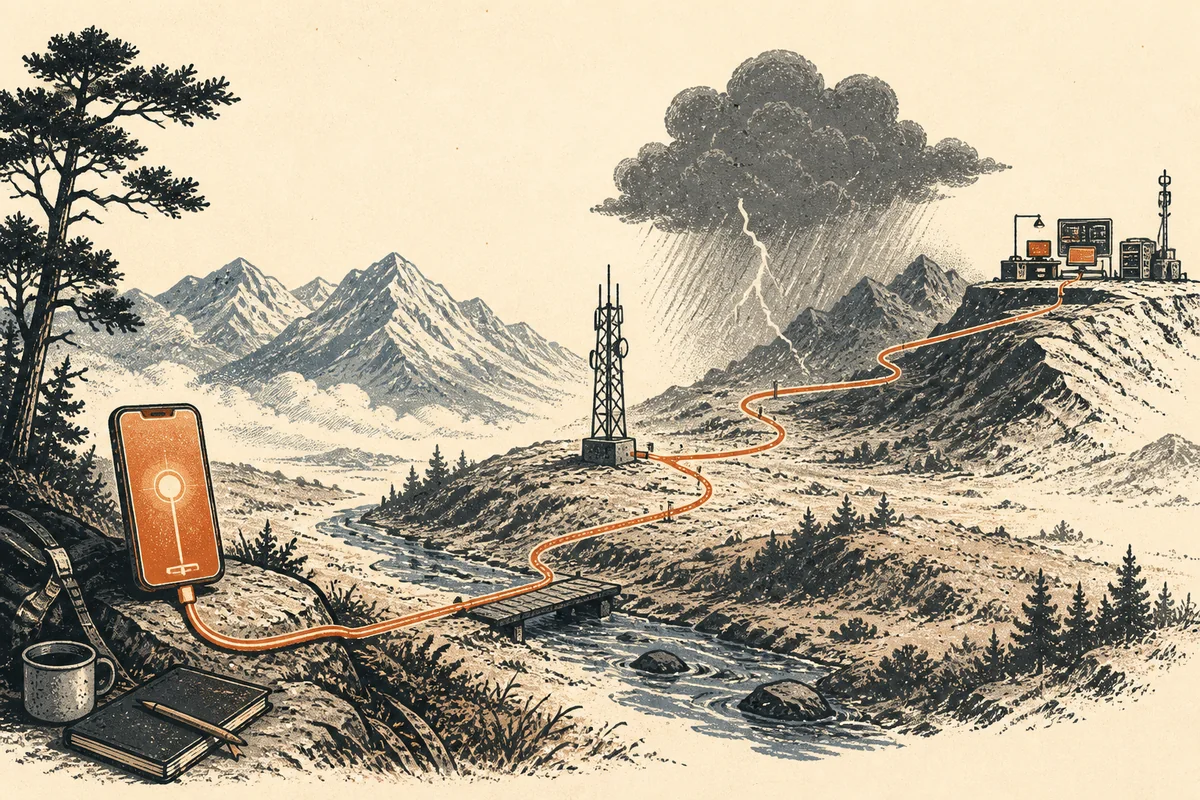
I run long agent jobs on a host at home and want to steer them from my phone, from a train or a café, whatever network I am on. Anthropic now ships a built-in answer for this, Remote Control, which connects a phone or browser to a Claude Code session on your machine. In this note I examine why I still reach a terminal instead, and why I expect that choice to flip. My current setup is four ordinary tools, each doing one job.
The four-tool terminal stack
Tailscale gives the host a stable address I can reach from anywhere. It builds a mesh VPN (virtual private network) of direct encrypted tunnels between my devices, using STUN (session traversal utilities for NAT) and ICE (interactive connectivity establishment) style hole punching to cross NAT (network address translation), and in its own words: “The private key never, ever leaves its node.” When a network blocks the direct path, traffic falls back to an encrypted relay, but the common case stays peer to peer.
mosh (mobile shell) handles the moving. It logs in over SSH (secure shell), then runs its own server and connects over UDP (user datagram protocol), so the session survives what plain SSH cannot: “Mosh automatically roams as you move between Internet connections. Use Wi-Fi on the train, Ethernet in a hotel, and LTE on a beach: you’ll stay logged in.” I can sleep the phone and wake it an hour later with the session intact.
tmux keeps the work alive when every client is gone. Detached sessions “keep running in the background”, so the agent keeps working whether or not anything is attached. I have written about keeping orchestration on the lowest workable layer on its own; here it is the tmux orchestrator the other three reach.
Termux is the last piece, “an Android terminal application and Linux environment”, which is the keyboard and the screen. The phone side is a plain TTY (teletypewriter) onto the mesh, with nothing agent-specific running on it. Each layer is replaceable, and none of them knows what an agent is; that property is what keeps the stack tool-agnostic.
Remote Control and its limits
Remote Control is the more elegant idea. The local process makes
outbound HTTPS requests only, keeps every inbound port closed, registers with
the API and polls for work, so “nothing moves to the cloud” and typing
@ autocompletes local file paths on the phone. For steering a session
you left running it is less setup than anything I maintain: one command,
a QR (quick response) code, done.
Three limits, taken from its own documentation, keep me on the terminal
for now. (1) Commands that open an interactive picker, “such as /plugin
or /resume, work only from the local CLI”, so part of my command
surface is simply missing from the phone. (2) If the machine is awake but
offline “for more than roughly 10 minutes, the session times out and the
process exits”, which is exactly the failure a long unattended run has to
survive. (3) It is gated to a claude.ai subscription on
api.anthropic.com, with API keys and third-party endpoints
unsupported, so it steers one vendor’s agent and not the others I run
beside it.
The terminal’s advantages
In contrast, the terminal’s advantages are ordinary and, for my use, decisive. It is tool-agnostic: the same mesh steers a second agent running in the next pane as easily as the first, because it steers a shell rather than a product. It carries the complete command surface, every slash command and skill included, since it is the identical terminal I use at my desk. In addition, its persistence is owned by tmux and mosh rather than by a relay, so a run outlasts a tunnel that dropped for an hour just as it outlasts one that dropped for ten minutes. That breadth, however, has a setup cost: I rebuild reachability, persistence, and a mobile keyboard by hand on each new host.
Remote Control’s current advantages
I am not arguing against Remote Control. The vendor path already has what my stack cannot cheaply reach: push notifications when a “long-running task finishes or when it needs a decision” (Remote Control docs), a real mobile interface rather than a terminal viewed on a phone, device-level trust, and an active release cadence from the vendor. Once a pushed notification matters to me more than steering a second agent, I will move to Remote Control. On current trajectory, that is not far off.
TODO (2026-07): run a week with Remote Control as the only path to one host and count how often the missing picker commands and the 10-minute timeout actually cost me something, against how often a push notification saves a stalled run. The honest comparison is a measured one, and I have not measured it yet.